My top reads of 2025 show why connection and communication aren’t soft skills but essential to leadership and organizational success.
It’s that time of year – business slows down and holiday traditions and rituals come into play. Gatherings with neighbors and family fill weekends, and gift-giving and exchanging dominate many social events.
This also is the time of year when we engage in reflection: what went well, what do we need to change or improve, and how will we get to where we really want to go?
As I go down this contemplative path, I want to share my top reads of 2025. Yes, I am looking through my communications filter. These books support my view that our strongest leaders are those who recognize that connection and communication are not soft skills but central to human thriving and organizational success.
Those who wish to lead and influence others treat communication as a discipline — something to study, refine, and practice.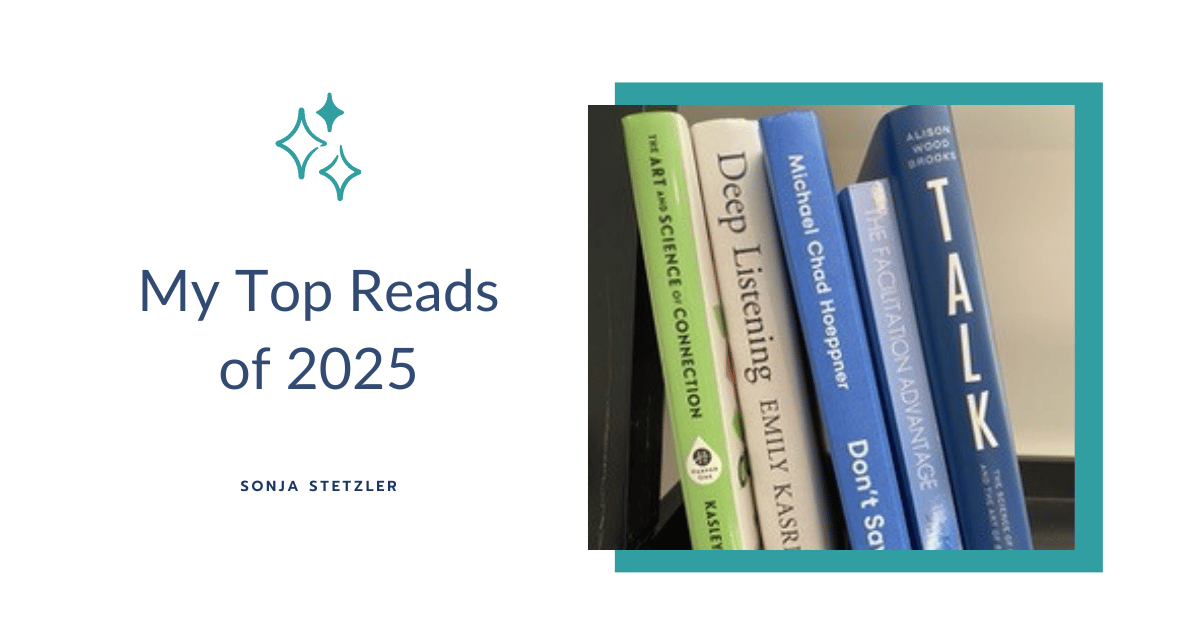
Here are my top reads of 2025:
1. “The Art and Science of Connection: Why Social Health is the Missing Key to Living Longer, Healthier, and Happier” by Kasley Killam
Having a background in healthcare, this book was of particular interest because in many cases social health is the missing ingredient in our overall “pillars of health”.
The author offers a “social fitness” framework that includes assessing the breadth and depth of one’s relationships, intentionally building new connections, and deepening existing ties to create trust and collaboration.
The implications of adopting a shift could be a huge win for our health because the quality of one’s relationships predicts longevity, stress resilience, and performance.
2. “Deep Listening: Transform Your Relationships with Family, Friends, and Foes” by Emily Kasriel
Many of us forget that listening is 50% of the communication process. This book is a reminder that hearing is not listening.
This book offers eight principles for intentionally listening more deeply to understand, not respond. Creating space, recognizing distractions, being present, bringing curiosity, becoming comfortable with silence, reflecting back on what was said, self-awareness of non-verbal communication, and going deeper.
This book is a guide to better listening as it leads to more accurate decision-making, improves conflict management, and enhances innovative team dialogue.
3. “Don’t Say ‘Um” by Michael Chad Hoeppner
This book is not all about eliminating ‘filler words’ when speaking. I appreciated the physical and cognitive exercises this book offers, many of which I had not used and have now adopted in my coaching practice, to improve public speaking skills.
And even though I was trained to view speaking as a performative art, this book emphasizes making a connection with your audience – which is the heart and soul of a memorable presentation.
4. “The Facilitation Advantage” by Kat Koppett and Therese Miclot
I know Kat Koppett as we are both members of the Applied Improvisation Network, and her new book’s premise is that facilitation is no longer a niche skill; it is a core requirement for leaders these days.
I liked this book as it serves as a practical guide drawing from applied improvisation, storytelling, and experiential learning to teach facilitation skills. If you lead teams (or would like to lead your team to higher productivity), this one is for you.
5. “Talk: The Science of Conversation and the Art of Being Ourselves” by Alison Wood Brooks
Last, but not least, this book was my favorite out of all the books I read this year. We tend to think that conversations just happen, yet this book offers a framework for more engaging and satisfying conversations:
T – choosing meaningful topics,
A – ask questions to build rapport and uncover insights,
L – add levity with humor to connect emotionally,
K – kindness is key to civility.
Brooks’ book is grounded in research and provides a practical guide to developing better relationships through conversation.
Connection isn’t a soft skill—it’s THE skill
The through line for my top books this year is that connection and communication are not soft skills, but central to human thriving and organizational success. Isn’t that what effective connecting is all about?
What books stood out and shaped your thoughts and work this year? Let me know – I’m always on the lookout for a good read!
Enter your name and email below to grab my FREE Speaker Checklist to feel fully prepared and confident to deliver your very best.