Responsive Communication Starts Before You Speak
As I look back on the new clients I have worked with, I see consistent responsive communication challenges. Even though my clients were in different industries and had varying lengths of experience in their respective roles, at least one if not more of our sessions focused on how to answer questions ‘off the cuff’.
Whether in a meeting with senior leaders, the Q & A section of a presentation, or even a 1:1 meeting with their manager, the challenge was ‘how do I respond effectively when I am put on the spot?’

These are the challenges my clients brought to their session:
“…I don’t do well with answering questions and providing insight on the fly.”
“I struggle with confidence and second-guess how my thoughts will come across, including whether I am articulating them clearly in the moment.”
“I have a challenge structuring and articulating my thoughts especially in interviews. I generally prepare for a meeting but struggle to articulate my thoughts clearly when put on a spot.”
“I have a dismissive boss. How can I better manage my reactions to his comments – as I can be direct and sometimes say things to my own detriment?”
There is a common theme that runs through each of these comments – and it precedes offering a framework to organize one’s thoughts to answer coherently.
When we are put ‘on the spot’ we instinctively go into a self-protective mode which limits our ability to respond in an organized manner. The challenge then becomes how do we become responsive vs. reactive to be more effective with our communication?
Reactive vs. Responsive Communication
When we’re reactive, we’re communicating from our nervous system. The conversation becomes about protecting ourselves—our reputation, our position, or our emotions. We interrupt, defend, justify, blame, or mentally rehearse our rebuttal while the other person is still speaking.
Being responsive, on the other hand, means communicating from choice rather than impulse. We still have emotions, but they don’t drive the conversation. Instead, we create enough space to understand before being understood. Responsive communicators regulate themselves first, enabling them to stay connected to both the conversation and the person.
Here are three ways to become more responsive instead of reactive:
1. Notice the first signal – before the first word.
Most people don’t become reactive the moment they speak—they become reactive the moment their body perceives a threat. Your personal “early warning system” signs may include:
- An increase in heart rate
- Shoulders tighten.
- Breathing becomes shallow.
- Feeling the urge to interrupt.
The goal here isn’t to eliminate emotion. It’s to recognize emotion before emotion begins speaking for you. Taking a beat, a short pause, or a quick breath can help to mitigate a reactive response.
2. Replace certainty with curiosity.
When we’re reactive, we assume we know the other person’s motives, and we may be thinking:
- “They’re criticizing me.”
- “They’re dismissing my idea.”
- “They don’t respect me.”
Responsive communicators trade assumptions for questions.
For example: instead of: “You’re wrong.”
Try: “Tell me more about how you arrived at that conclusion.”
Curiosity lowers defensiveness—for both people.
3. Respond to the purpose—not the provocation.
Reactive communication focuses on the last sentence. Responsive communication focuses on the desired outcome of the conversation.
Internally ask: “What response will best serve the relationship and the result?”
It’s difficult to stay reactive when you’re intentionally thinking about the future rather than simply reacting to the present.
Before you find the right words, regulate your response.
Eloquently speaking ‘off the cuff’ is a challenging skill to master; however, the first step in mastery is self-regulation.
Reactive communication is self-protective. Responsive communication is relationship-protective.
What helps you stay calm and communicate clearly when you’re put on the spot?
Your first response doesn’t have to be your final response.
When a conversation catches us off guard, our nervous system often answers before we do. 💭
My free Reactive vs. Responsive Communication infographic sets five shifts side by side. It can help you recognize what’s happening in the moment and choose your response with intention. ✨
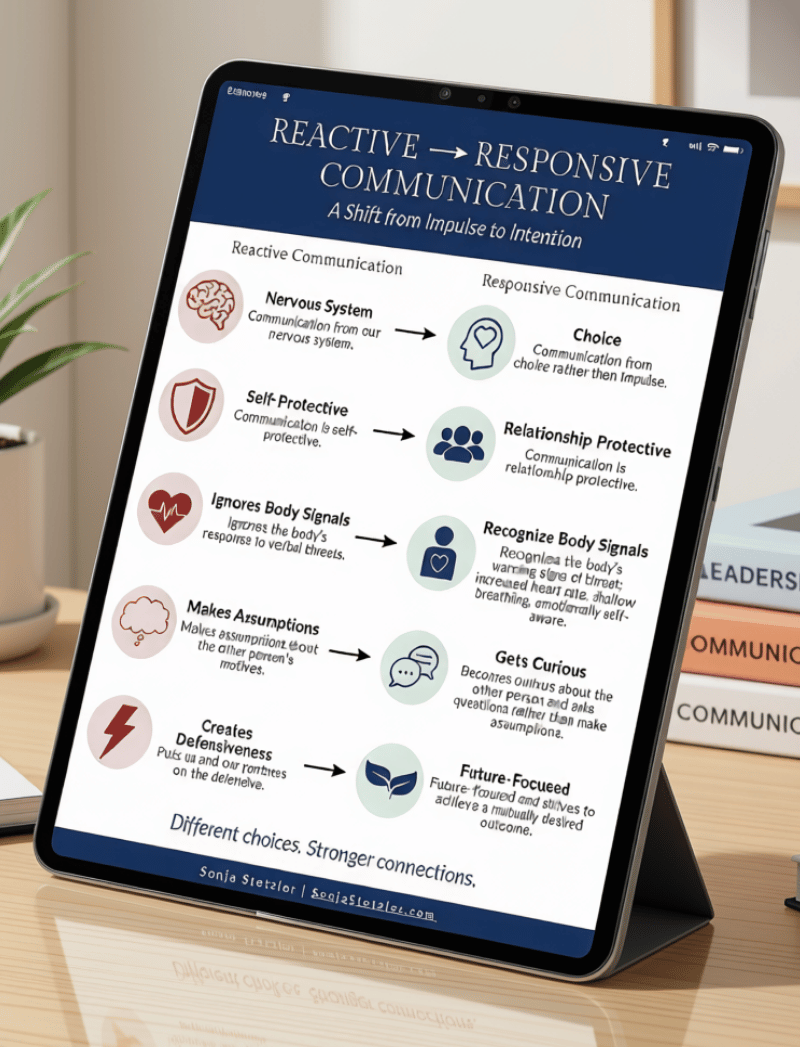
Enter your name and email below to download and keep it close for the conversations that matter most.