
Communication and professional visibility are more connected than most people realize.
One of my new projects this season is book writing. I’ve had this project on the back burner for a while and have finally decided that this is the season to take it off the shelf and get it done. As a speaker, I’m often asked if I have written a book. Now it is in the works.
My premise is that effective connecting determines career success. And my objective is to reframe communication from a “soft skill” to a career differentiator. If you would like to be on the waitlist for when the book will be available, please complete the form below:
One of the chapters in my book will focus on communication as a visibility factor. Your performance creates results; however, communication creates visibility. In many professional environments, people (especially women) assume their work will speak for itself.
We think if we produce strong results, meet deadlines, solve problems, and contribute value, surely others will notice. Right? In reality, the work rarely speaks for itself.

Communication Speaks for the Work
In our work settings, visibility is not created by what we accomplish. Visibility is created by how we communicate ideas, insights, and progress.
Most don’t see the full process behind our work – they experience us in fragments: meetings, conversations, emails, presentations, and quick updates in the hallway or on a video call.
Those moments become the lens through which our contributions are interpreted. Work creates value. How we communicate about our work reveals value.
Visibility Is Built in Micro-Moments
Many professionals assume visibility is created during large, formal events: major presentations, senior leadership or board updates, or conference talks.
While those moments certainly matter, most professional visibility develops in much smaller ways:
- The contributions made during meetings
- The clarity of emails
- The ability to ask insightful questions
- Nonverbal presence when others speak
- Succinctly summarizing complex ideas
These moments add up over time. They shape how others think of you:
- “She explains things clearly.”
- “He always asks thoughtful questions.”
- “She has a calm presence when things get chaotic.”
Those impressions gradually become your professional identity.
Communication Creates Identity
Communication is more than sharing information; it signals who you are. Every time you speak, through your words and nonverbal communication, you signal:
- confidence
- clarity of thinking
- judgement
Additionally, if you are someone who consistently communicates with poise, insight, and connection, you may be identified as a leader.
Effectively Connecting
Visibility is not necessarily about speaking more. It’s about communicating in ways that connect. Those who stand out are rarely the loudest voices in the room. Instead, it is often those who communicate in a way that connects.
People become visible when their communication:
- clarifies complexity
- acknowledges others’ perspectives
- builds common ground
- advances the conversation
Over time, these communication behaviors increase both influence and visibility.
Visibility is Intentional
In your work environment, if someone observed how you communicate—your questions, comments, tone, and presence—what conclusions would they draw about you?
For many professionals, this question reveals an important insight. Visibility is not accidental. It is intentional. It’s about how we communicate.
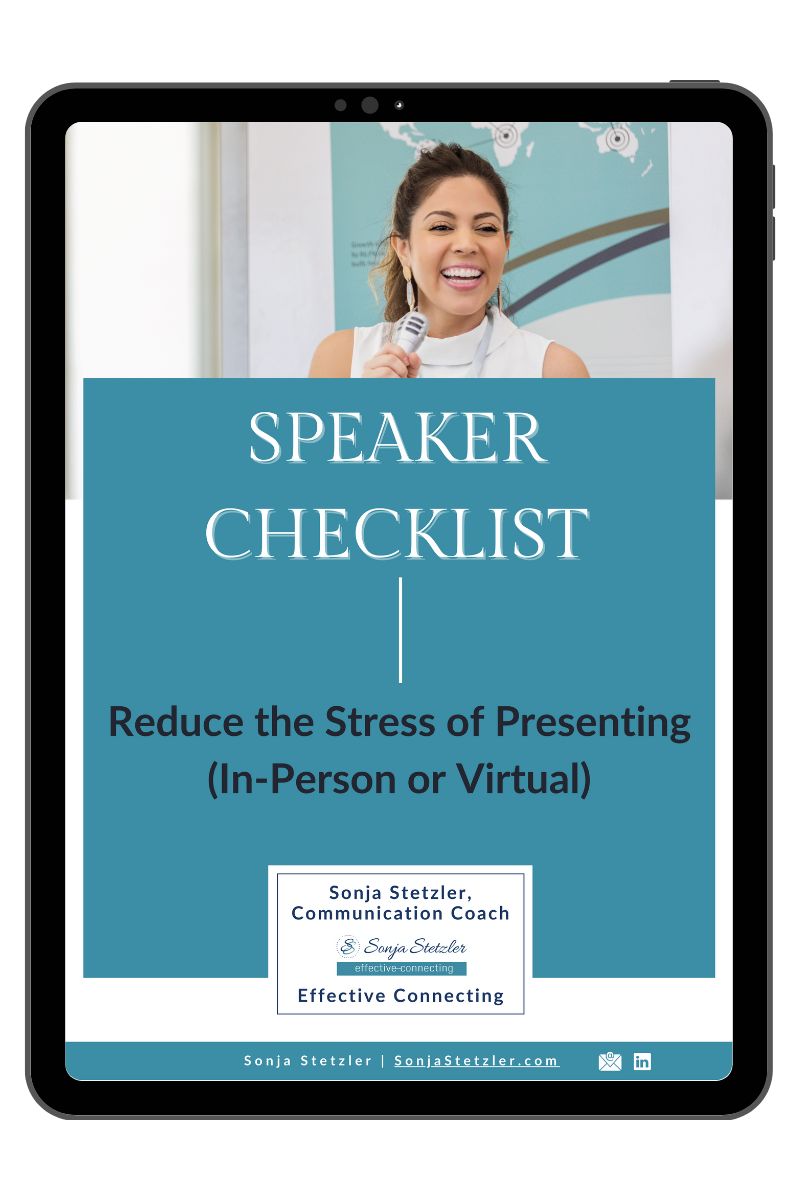
Enter your name and email below to grab my FREE Speaker Checklist to feel fully prepared and confident to deliver your very best.