Why reading the room matters more than the perfect script.
An underrated communication superpower is the ability to “read the room”. Whether you are on a stage, leading a boardroom discussion, or simply sitting around the dinner table with family, the ability to notice what’s happening around you—and adjust in real time—is one of the most valuable communication skills you can develop.
Unfortunately, many people confuse great communication with delivering the perfect message. They spend hours polishing their slides, rehearsing their talking points, or planning exactly what they’re going to say. But communication isn’t a performance. It’s an interaction. And interactions require awareness.
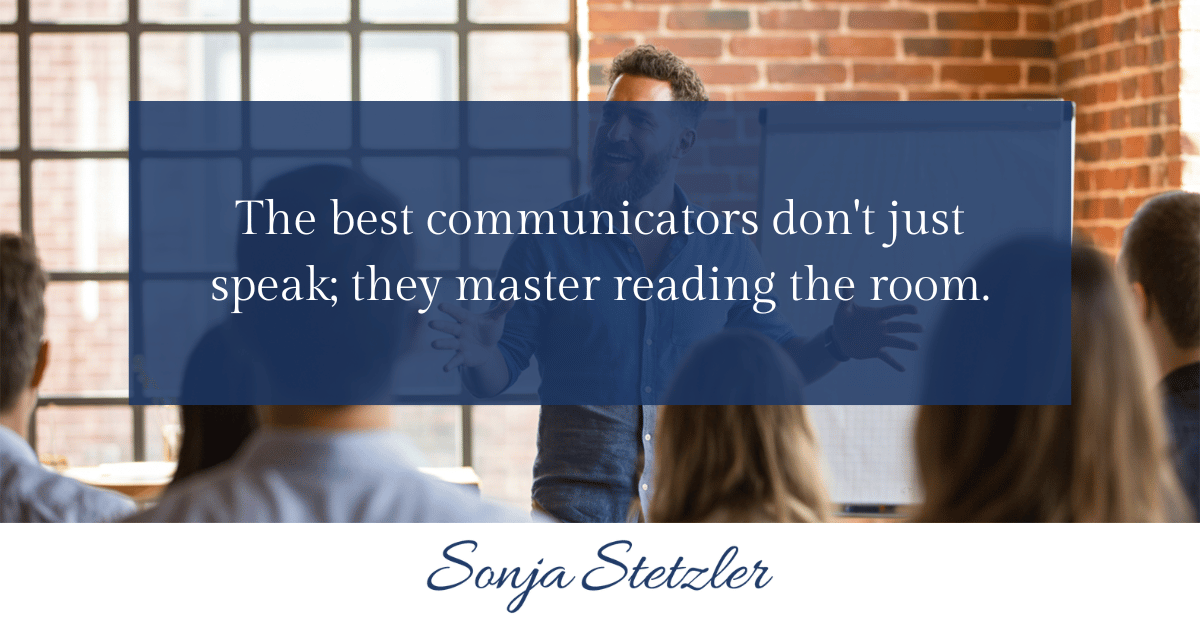
Reading the room means paying attention to the signals an audience is sending before a word is delivered. Are people leaning in or checking their phones? Do they look energized or mentally exhausted? Has the conversation become tense? Confused? Disengaged?
Sometimes the room tells you it’s time to speed up; sometimes it tells you to slow down. Sometimes it tells you to ask a question instead of giving another answer. The best communicators don’t simply deliver information, they consciously use the power of noticing to gather information, then adjust.
Your Brain Is Already Reading the Room
What’s fascinating is that neuroscience suggests our brains are constantly scanning our environment for social and emotional cues—even when we’re not consciously aware of it.
Long before someone speaks, we notice facial expressions, body language, vocal tone, eye contact, and even subtle shifts in energy. Researchers refer to this as social cognition—our brain’s remarkable ability to interpret what others may be thinking or feeling based on nonverbal information. It’s one reason we can walk into a meeting and immediately sense that something feels “off,” even if no one has said a word.
When the emotional climate of a room is ignored, people disengage, trust may be lost, and people become less open to new ideas.
On the other hand, when people feel they are understood, their brains are more likely to shift out of a defensive state and into one that supports trust, collaboration, and problem-solving.
Assumptions Get in the Way of Connection
One of the biggest obstacles to reading the room is our assumptions. When we assume we already know what people are thinking, we stop observing. We become attached to our agenda instead of becoming curious about theirs.
Rather than thinking, I know what this audience needs, we need to ask ourselves:
- What am I noticing?
- What energy is in the room?
- What might my audience need from me right now?
Reading the room isn’t about mind reading. It’s about pattern recognition. It’s noticing facial expressions, body language, tone of voice, participation levels, and even silence. Often, what isn’t being said communicates just as much as the words we hear. The good news is this superpower can be developed.
I encourage you to challenge yourself to become a student of observation:
- Before speaking, take ten seconds to scan the room.
- Notice people’s posture and facial expressions.
- Listen to the energy rather than just the words.
- Be curious. Curiosity keeps us flexible and allows us to make adjustments that create connection instead of simply delivering content.
Connection Is the Real Goal of Communication
The goal of effective communication isn’t simply to say what you planned to say. The goal is to connect. And sometimes the most effective communicator isn’t the one with the best script. It’s the one who notices when the room needs something different.
Communication isn’t something we do to people. It’s something we create with them.
What’s one situation where reading the room changed the outcome of a conversation? I’d love to know how you handled it.
Enter your name and email below to grab my FREE Speaker Checklist to feel fully prepared and confident to deliver your very best.